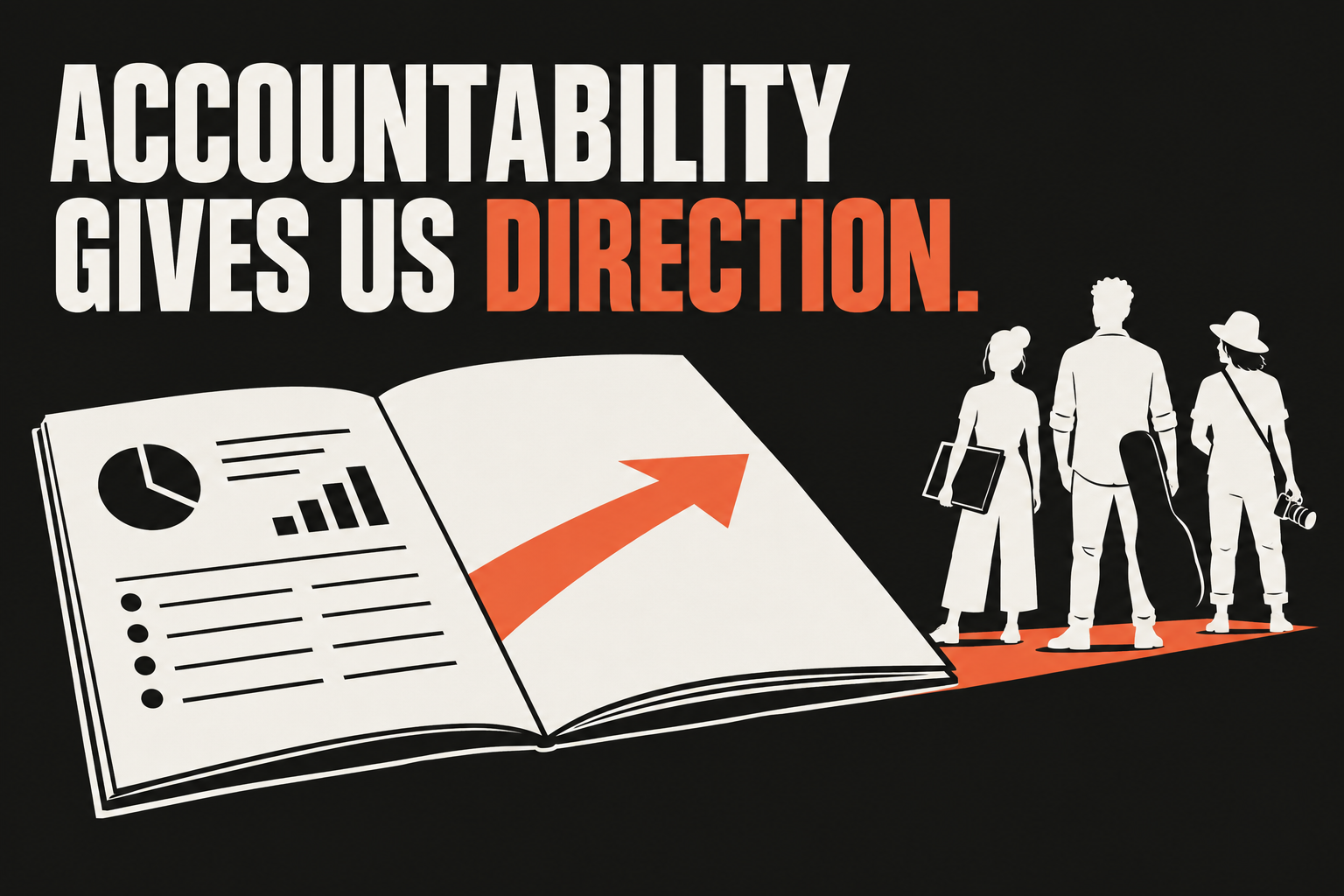
Financial accountability gives an institution the information it needs to understand its decisions, improve its work and measure progress. Checking whether money was spent correctly, and identifying irregularities where they exist, are essential responsibilities. But the value of accountability goes further.
When financial reporting is connected to clear objectives and measurable results, it allows us to ask better questions. What did we set out to achieve? What resources did we commit? How far have we progressed? And what should we do differently?
For Aruba’s cultural and creative industries, those questions matter. If our ambition is to grow creative businesses, improve livelihoods and create employment, we need a credible starting point against which to measure progress. We need targets, and we need to understand which investments are helping us reach them.
Financial reporting shows where the money goes. Performance reporting helps us understand what it achieves. We need both.
A balanced budget alone cannot tell us whether a cultural policy is working. Neither can a successful event or a well-attended programme. Those activities may have value, but we must also look at what happens afterwards. Are professionals finding more paid work? Are businesses becoming more sustainable? Are we reaching new markets and expanding opportunities across the island?
Reliable reporting helps us compare our progress over time, recognise effective approaches and change those that are falling short. It also gives us a basis for setting realistic budgets and defending investments that produce results.
Accountability gives us more than oversight. It gives us direction.
A letter from the College Aruba financieel toezicht, dated 9 October 2019, illustrates why the reporting foundation matters. CAft requested missing financial statements across government entities and foundations, including accounts for UNOCA and Stichting Schouwburg Aruba for 2015 through 2018. It also reported that a required financial report for the collective sector had not been received.
That letter does not establish these institutions’ current reporting status or prove misuse of funds. It documents a reporting gap at that time. Such gaps limit our ability to understand how resources have been managed and, when considered alongside performance information, whether they are delivering public value.
Creative professionals are expected to justify budgets and demonstrate results. The institutions that fund, direct and serve the sector must meet that same standard.
Accountability cannot stop at the applicant’s door.
Go Cultura Foundation has repeatedly raised concerns with the departments responsible for overseeing cultural funds. In our experience, the higher we took those concerns, the less attention they received. That experience has strengthened my conviction that an accountable system must also be a responsive one. Concerns need to be examined, questions answered and decisions explained.
As we develop Aruba’s cultural and creative industries, we have an opportunity to establish these practices from the outset. The sector must have a meaningful role in shaping its future, supported by clear responsibilities, transparent funding and professional leadership.
Independence alone will not deliver this. An autonomous institution can reproduce the same failures if its governance is weak.
Sector leadership and public accountability must be built together.
That is the standard we want to establish through CreActivo. We need accountability to understand our own performance, demonstrate results and recognise when we need to change course.
The mapping provides a starting point for understanding the sector. From that baseline, we need to define what progress should look like, set measurable targets and report against them consistently. We should be able to explain what we invested, whom we reached, what improved and what remains unresolved.
We must also be prepared to publish where we fall short. A missed target should lead to an honest assessment of why it was missed and what needs to happen next. That is how an institution learns and earns confidence.
Building a new organisation gives us the opportunity to put sound governance in place from the beginning, while recognising the knowledge, relationships and work already present in the sector.
Our ambition is an emerging economic pillar that creates livelihoods, strengthens Aruban identity and broadens participation in the island’s prosperity. Cultural and economic value deserve to be understood and supported with evidence.
We intend to move forward proudly, with clear goals and real numbers showing where we started, how we are progressing and what still needs to improve.
Aruba’s creative economy deserves public confidence. We are prepared to earn it.